
Young people across the country are expecting their GCSE and A-Level results this week. This article contains a brief overview of the appeals process for any students wishing to appeal their grade(s).
The information has been taken from the Joint Council for Qualifications (JCQ) Guidance on the determination of grades for A/AS Levels and GCSEs for Summer 2021 and Ofqual’s Student guide to awarding summer 2021.
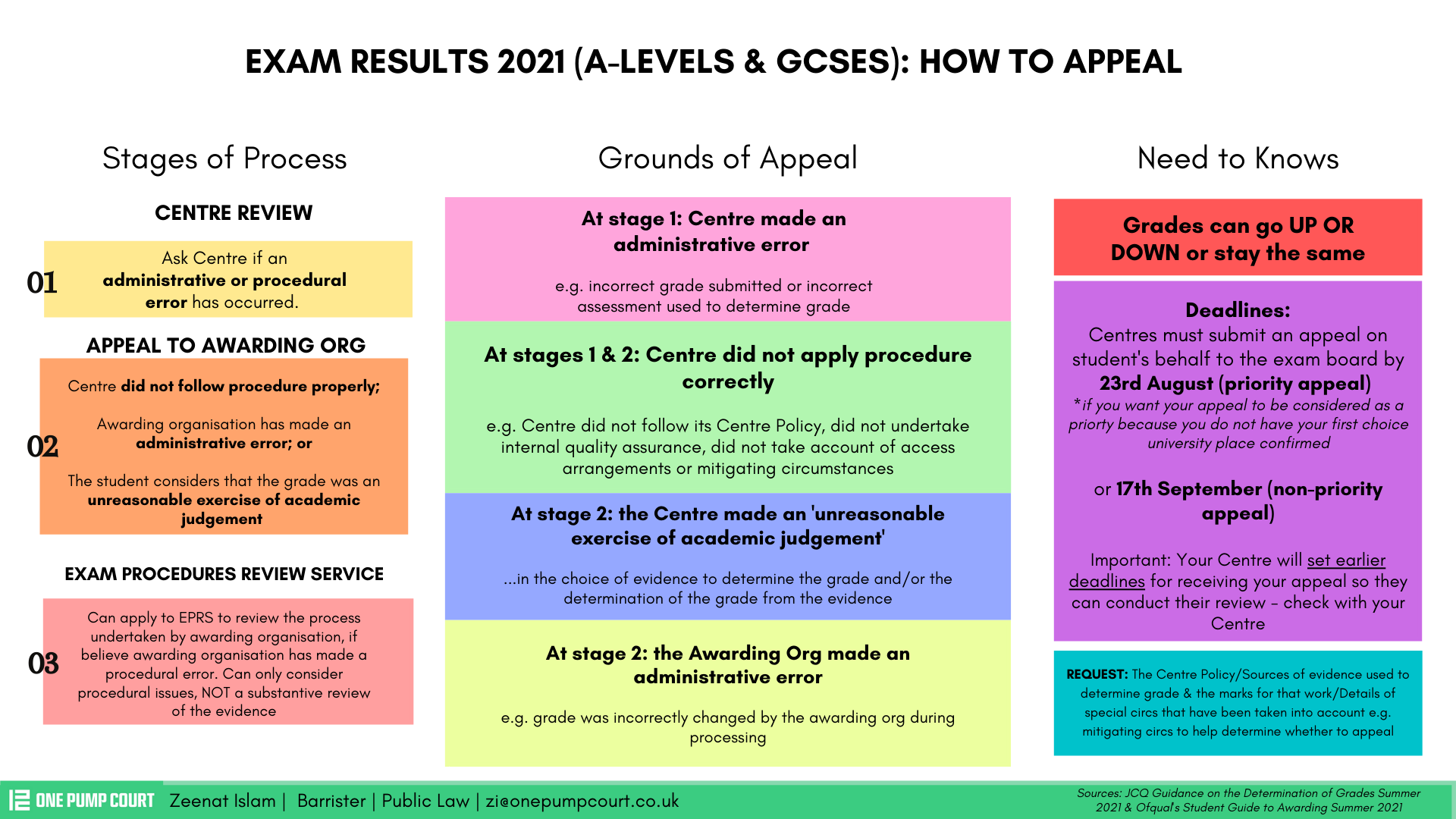
A Centre is your school/college that has issued the student’s grade. If the student believes they have been given the wrong grade, they can ask their Centre to see if an administrative or procedural error has been made.
If an error is found, the Centre will request that the awarding organisation corrects the grade.
Students need to be informed of the outcome of the Centre Review. If they wish to appeal to the Awarding Organisation, a student must submit a request to their Centre to submit the appeal.
The Social Mobility Foundation has devised a number of helpful resources that can be used including a template letter, requesting a Centre Review which can be adapted according to your needs.
The student’s Centre must submit an appeal to the Awarding Organisation on their behalf, if the student requests it. The appeal must be in accordance with any specific requirements of the particular Awarding Organisation.
An appeal can be made if the student believes:
If a student or Centre, believes that there has been a procedural error by the Awarding Organisation in conducting the appeal, an application can be made to the EPRS. The EPRS will only consider procedural errors and will not conduct a substantive review of the evidence.
Extracted from the JCQ’s Guidance on Summer Exams 2021
What is ‘unreasonable exercise of academic judgement’?
The JCQ Guidance states:
‘A reasonable judgement is one that is supported by evidence. An exercise of judgement will not be unreasonable simply because a student considers that an alternative grade should have been awarded, even if the student puts forward supporting evidence. There may be a difference of opinion without there being an unreasonable exercise of judgement. The reviewer will not remark individual assessments to make fine judgements but will take a holistic approach based on the overall evidence.’
If considering an appeal the following documents will be important:
Below is a non-exhaustive list of further support and information for young people who are affected by this year’s results process:
For a second consecutive year, young people have suffered significant disruption to their education as a result of the Coronavirus pandemic. Young people hoping to progress onto college and university have been unable to undertake their examinations, with grades this year being determined by teachers – Teacher Assessed Grades (TAGs). Whilst this is a departure from Centre Assessed Grades (CAGs), the process used in Summer 2020 which resulted in the exam results 2020 fiasco, concerns remain, particularly for those from the most disadvantaged backgrounds.
Last year, concerns were raised about teacher bias in relation to predicted grades, the same considerations which may also apply to TAGs. The Equality Act Review compiled a report which analysed 2091 responses and found that:
More recently, The Sutton Trust prepared a research brief which explores how the pandemic has particularly affected those from lower socio-economic backgrounds. It examines the impacts across three broad areas; the impacts on learning, the impacts on exams and assessment and the impact on the university application and entry process. Whilst young people from all backgrounds are affected the report states that there are ‘additional threats to equity and fairness as the poorest have been hardest hit.’
The report made a number of key findings, raising significant issues as to the widening educational inequalities between young people in private schools and those in state schools, for example:
These findings are made in the context of recent analysis of the government’s handling of education during the pandemic which states that ‘the biggest single failure has to be the refusal to make contingency plans over the summer and autumn of 2020, the biggest impact of which was the failure to have anything in place to handle the second cancellation of exams in 2021.’
It remains to be seen whether the government’s handling of education during the pandemic will form part of the Terms of Reference for the COVID Public Inquiry which is due to be held in Spring 2022.
Zeenat Islam is a public law barrister at One Pump Court Chambers with specialist experience in Public Inquiries and issues affecting young people from underrepresented backgrounds. More about Zeenat can be found here.